
Premium Fragrance Manufacturing: Four Mistakes an Influencer Line Can Skip
Premium is a process, not a price tag. The lines that fail at the high end almost never fail because the scent was cheap; they fail because one of four decisions was made too late, in the wrong order, or without a test behind it. An influencer line can skip all four by treating the brief, the packaging, the stability hold and the compliance file as parts of one product plan rather than as separate purchases.
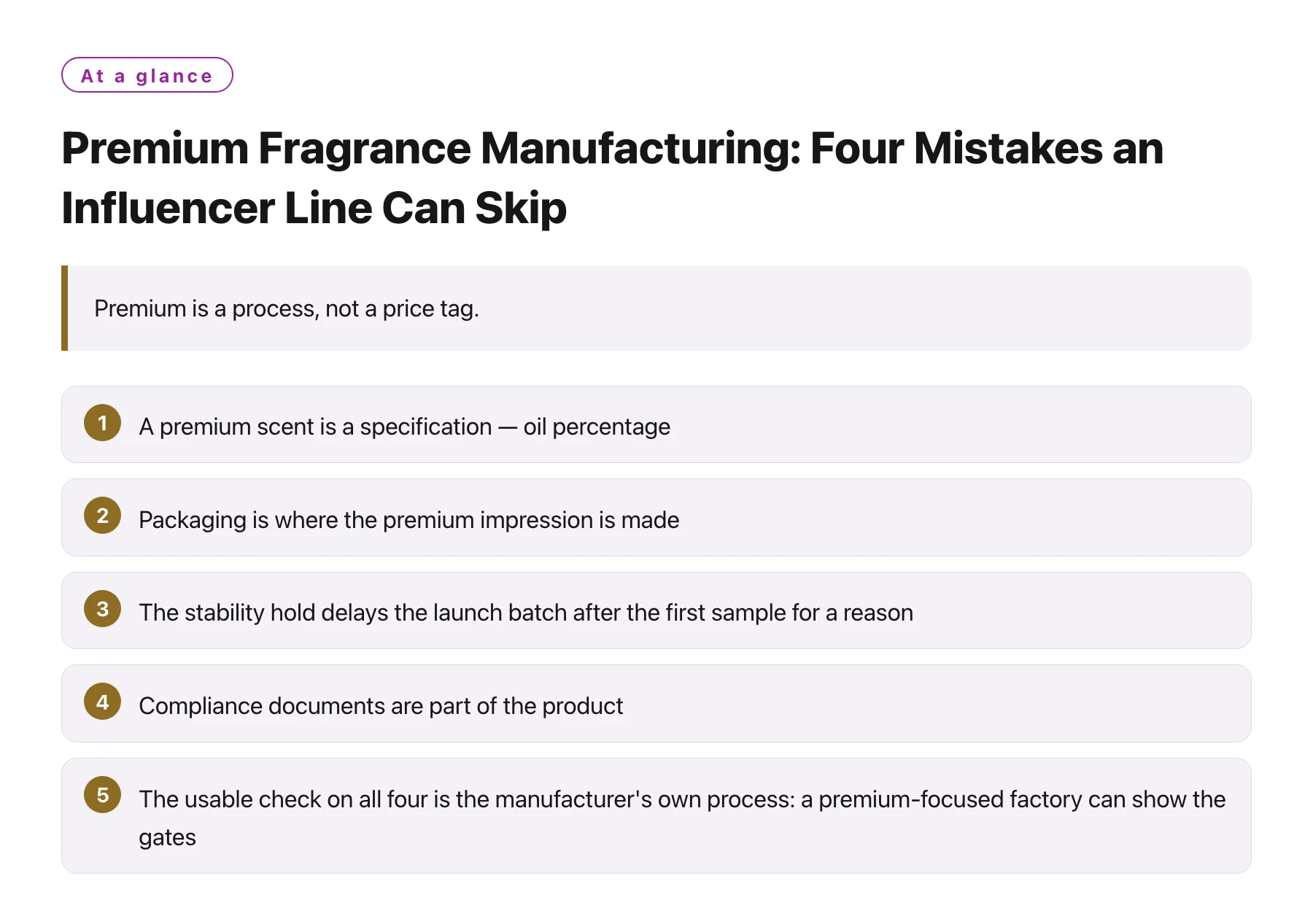
Key takeawaysA premium scent is a specification — oil percentage, raw material budget and exclusivity — decided before anyone designs a bottle. · Packaging is where the premium impression is made, but it can only express what the formula inside already supports. · The stability hold delays the launch batch after the first sample for a reason, and skipping it is the fastest way to ship a different perfume than the one approved. · Compliance documents are part of the product; a premium line without a complete file is a premium claim without evidence. · The usable check on all four is the manufacturer's own process: a premium-focused factory can show the gates, not just the certificates.
Every season brings a handful of indie fragrance launches that look inevitable on paper — strong scent, gorgeous bottle, an audience that already follows the founder — and then stall in production. When they stall, the cause is almost never the price of the raw materials.
It is usually one of four process mistakes: a brief that arrived after the packaging, a bottle bought before the formula was stable, a launch date set before the stability hold finished, or a compliance file assembled after the first production run instead of before it.
This article walks through those four mistakes and the gates that stop them, written for an influencer founder who wants the line to arrive in the state it was approved in.
What 'premium' means on a factory floor
On a factory floor, premium means three measurable things: a higher oil percentage in the finished product, a raw material budget that buys the good versions of each ingredient, and tighter process control on every batch. Market researchers who track how consumers define premium in beauty keep returning to the same three signals — the scent, the packaging and the story [2].
Notice what is not on that list: a logo, a price or a celebrity name. A factory cannot manufacture status, but it can manufacture the three measurable parts, and a brand that wants to be perceived as premium should build the line exactly there.
This is also why the manufacturer's process position matters. The same equipment and the same staff can serve both a mass-market line and a luxury line; what changes is the specification and the number of checks applied. A plant organised around their OEM/ODM manufacturing services can therefore serve both without changing its identity, and the buyer's job is to check that the premium line gets the premium checks their OEM/ODM manufacturing services.
The four mistakes, and the gate that stops each one
Mistake one — the brief arrives after the bottle
The founder falls in love with a flacon, and the scent brief is written to fit the bottle instead of the other way around. The gate that stops this is an order of work: oil percentage and raw material budget first, packaging brief second. Fragrance ingredients are safety-assessed before they go into consumer products, and a formula that must survive that assessment comfortably cannot be an afterthought [1].
Mistake two — the bottle out-spends the liquid
A heavy glass bottle with a thin formula inside is the classic premium failure: the customer buys it once, smells the gap, and does not return. The gate is a budget ratio decided in the brief — what share of unit cost goes to the concentrate and what share to packaging — so the two are never designed in isolation.
Mistake three — the launch date beats the stability hold
A concentrate can smell beautiful in a two-week-old sample and change by week eight; alcohol, glass, cap materials and ageing all act on it. Stability and compatibility testing is standard professional practice in finished cosmetics, and it takes weeks [3]. The gate is a calendar: the launch date is set after the stability hold, never before it.
Mistake four — paperwork assembled after production
The final failure looks like this: the product ships, and only then does someone notice that the ingredient list, the allergen declaration or the market notification is wrong. Premium raises the expectation for documentation, not the opposite. The gate is a product file that opens at the first sample and closes at the first shipment, so the paperwork is never a rescue mission.
What the process check actually looks like
The four gates share one shape: each has a named owner, a named output and a date. A factory that works this way can walk you through the gates in a single meeting; one that cannot usually has a quality story that lives in anecdotes.
This is the moment to look at how a manufacturer describes its own premium capacity. A positioning such as Xuelei premium fragrance manufacturer is only useful if it is accompanied by the concrete parts — R&D, filling, decoration and certificates — that let you verify the claim rather than take it on faith Xuelei premium fragrance manufacturer.
Quality control in luxury fragrance production turns out to be less about exotic instruments and more about gates: the same checks, applied to every batch, including the ones after the brand has stopped looking quality control in luxury fragrance production.
If you take one habit from this article, make it this: write the product specification — oil percentage, raw material budget, packaging budget ratio, stability hold dates, document file — before you message a single factory. Everything a premium line needs is decided in that document, and everything that goes wrong later is a line that was left blank in it.
Sources
- IFRA: Safe Use and Fragrance Science —— IFRA's explanation of how fragrance materials are scientifically assessed for safe use and how those conclusions are applied by the industry.
- Mintel Press Centre —— Mintel's press releases on consumer and beauty market research, including fragrance and personal care trend reporting.
- Cosmetics & Toiletries —— A technical magazine for cosmetic formulators, covering ingredients, formulation science and testing methods.
Frequently asked questions
What actually makes a perfume feel premium rather than mass-market?
Three measurable things: a higher oil percentage, better versions of the raw materials, and stricter process control per batch. Packaging and story amplify those three; they cannot replace them.
Do premium fragrances need more compliance documents than regular ones?
The legal document set is the same, but the scrutiny is higher: a premium buyer, a premium retailer and the market regulator all read the file more carefully. Build the same file as a mass-market line and you are fine; build it late, and it shows.
Why does my sample smell great but the launch batch differently?
Usually the gap is time, not the factory: concentrates keep evolving after the sample is sent, and the difference appears between a two-week sample and an eight-week production batch. The stability hold exists to catch exactly this, which is why the launch date must be set after it.
Is a more expensive bottle a good way to justify a premium price?
The bottle justifies the price only if the liquid inside supports it. If the customer smells a gap between the packaging promise and the scent, the bottle becomes the reason they do not repurchase.
Can a small influencer line get the same process discipline as a big brand?
Yes, because the discipline lives in the factory, not in the brand. The question is whether the factory applies the same gates to a small run as to a large one, so ask to see the checkpoints — not just the certificate wall — before you sign.
Browse the full discography — 312 verified releases, four DSP links per entry.